
Encapsulation – Hiding Implementation Details with Java Modules

#open-source
#support-and-care
#maven
#java

In the first article (and its homework extension), we built a modular Java project with Maven 4 and exported all packages from our core module. But what happens when we have utility code that should stay hidden from other modules? Java Modules provide strong encapsulation to solve exactly this problem.
The Problem: Leaking Implementation Details
In Blog 1, our core module exports both its packages:
module com.openelements.showcases.analyzer.core {
    requires org.apache.logging.log4j;

    exports com.openelements.showcases.analyzer.core.model;
    exports com.openelements.showcases.analyzer.core.service;
}
This means every public class in model and service is part of the module’s public API.
Other modules can depend on any of these classes, making it hard to change internal implementation details later.
Consider our TextAnalyzer: it contains text normalization logic – lowercasing, stripping punctuation, splitting into words – directly in its methods.
This normalization is an implementation detail that other modules should not depend on.
If we extract it into a separate utility class, we want to ensure that only our core module can use it.
Creating an Internal Package
We extract the normalization logic into a new class TextNormalizer in a dedicated internal package:
src/com.openelements.showcases.analyzer.core/main/java/
├── module-info.java
└── com/openelements/showcases/analyzer/core/
    ├── model/
    │   ├── Document.java
    │   └── Statistics.java
    ├── service/
    │   ├── TextAnalyzer.java
    │   └── DocumentReader.java
    └── internal/                    ①
        └── TextNormalizer.java      ②
- New package for internal implementation classes
- Text normalization utility – not exported
The TextNormalizer provides two methods:
public class TextNormalizer {

    private static final Pattern NON_WORD_CHARS = Pattern.compile("[^\\p{L}\\p{N}]");
    private static final Pattern WHITESPACE = Pattern.compile("\\s+");

    public static String normalize(String text) {
        String cleaned = NON_WORD_CHARS.matcher(text).replaceAll(" ");
        return WHITESPACE.matcher(cleaned).replaceAll(" ").trim().toLowerCase();
    }

    public static String[] tokenize(String text) {
        String normalized = normalize(text);
        if (normalized.isEmpty()) {
            return new String[0];
        }
        return WHITESPACE.split(normalized);
    }
}
The normalize method lowercases the text, removes all non-letter/non-digit characters, and collapses whitespace.
The tokenize method normalizes and then splits the text into individual words.
Both methods use Unicode-aware patterns (\p{L}, \p{N}) to handle text in any language.
Our TextAnalyzer now delegates to TextNormalizer:
import com.openelements.showcases.analyzer.core.internal.TextNormalizer;
String[] words = TextNormalizer.tokenize(content);
Within the same module, TextAnalyzer can freely use TextNormalizer.
The key question is: can other modules access it too?
Controlling Visibility with module-info.java
Here is the updated module descriptor for our core module:
module com.openelements.showcases.analyzer.core {
    requires org.apache.logging.log4j; // ①

    exports com.openelements.showcases.analyzer.core.model; // ②
    exports com.openelements.showcases.analyzer.core.service; // ②
    // Note: com.openelements.showcases.analyzer.core.internal is NOT exported // ③
}
- Dependency on Log4j for logging
- These packages are exported – other modules can use their public classes
- The
internalpackage is deliberately not exported
The internal package does not appear in any exports directive.
This single omission is what makes TextNormalizer invisible to every other module -- despite being a public class.
Compile-Time Protection
What happens if the CLI module tries to import TextNormalizer?
// In AnalyzerCommand.java (CLI module)
import com.openelements.showcases.analyzer.core.internal.TextNormalizer; // ①
- This will not compile
The compiler rejects this with a clear error message:
error: package com.openelements.showcases.analyzer.core.internal is not
    visible
  (package com.openelements.showcases.analyzer.core.internal is declared
    in module com.openelements.showcases.analyzer.core, which does not
    export it)
The module system enforces encapsulation at compile time. You cannot accidentally depend on an internal class – the compiler prevents it.
Runtime Protection
Java Modules go further than compile-time checks. Even at runtime, the module system blocks access to non-exported packages.
If someone tries to use reflection to access TextNormalizer from another module:
// Attempting reflective access from the CLI module
Class<?> clazz = Class.forName(
    "com.openelements.showcases.analyzer.core.internal.TextNormalizer"
);
The runtime throws:
java.lang.IllegalAccessError: class ... cannot access class
    com.openelements.showcases.analyzer.core.internal.TextNormalizer
    (in module com.openelements.showcases.analyzer.core) because module
    com.openelements.showcases.analyzer.core does not export
    com.openelements.showcases.analyzer.core.internal
This is what strong encapsulation means: the boundary is enforced by the JVM itself, not just by the compiler. No workaround, no trick, no reflection hack can bypass it.
NOTE: If a module explicitly opens a package (via the opens directive), reflective access is permitted.
This is how frameworks like picocli or Hibernate can access annotated classes.
But opens is an explicit, deliberate choice by the module author – not something an external module can force.
Comparison with the Classpath
On the traditional classpath, any public class is accessible from anywhere.
There is no way to hide implementation details at the language level.
Naming a package internal is merely a convention that developers can easily ignore.
| Aspect | Classpath | Module Path |
|---|---|---|
| Public class visibility | Accessible from everywhere | Only if the package is exported |
| Internal packages | Convention only (e.g., naming) | Enforced by compiler and JVM |
| Reflection access | Always possible | Blocked unless the package is opened |
| Compile-time enforcement | None | Module system rejects illegal access |
Java Modules provide a fundamental improvement: you can define a clear public API for your module, and everything else is hidden by default.
Updated Module Diagram
With the internal package, our module structure now looks like this:
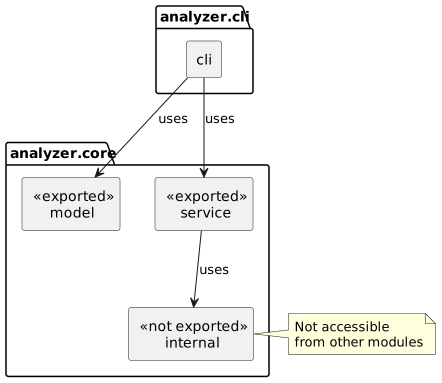
The internal package is used by service within the same module, but the CLI module has no access to it.
Source Code
The above changes are committed to the sample source code repository on GitHub.
Clone it and switch to branch blog-2-encapsulation:
git clone https://github.com/support-and-care/maven-modular-sources-showcases # unless already done
cd maven-modular-sources-showcases
git checkout blog-2-encapsulation
Summary
In this article, we have seen:
- How to create internal packages that are hidden from other modules
- The module system enforces encapsulation at both compile time and runtime
- Even reflection cannot bypass strong encapsulation (unless explicitly opened)
- This is a fundamental improvement over the classpath, where
publicmeans accessible from everywhere
The pattern is straightforward: packages listed in exports are your public API.
Everything else is encapsulated.
Homework
-
Qualified exports
Try changing themodule-info.javato use a qualified export:exports com.openelements.showcases.analyzer.core.internal to com.openelements.showcases.analyzer.cli;This makes the
internalpackage accessible only to the CLI module, but not to any other module. When would this be useful? We will explore this further in a future article.
Apache Maven and Maven are trademarks of the Apache Software Foundation.